
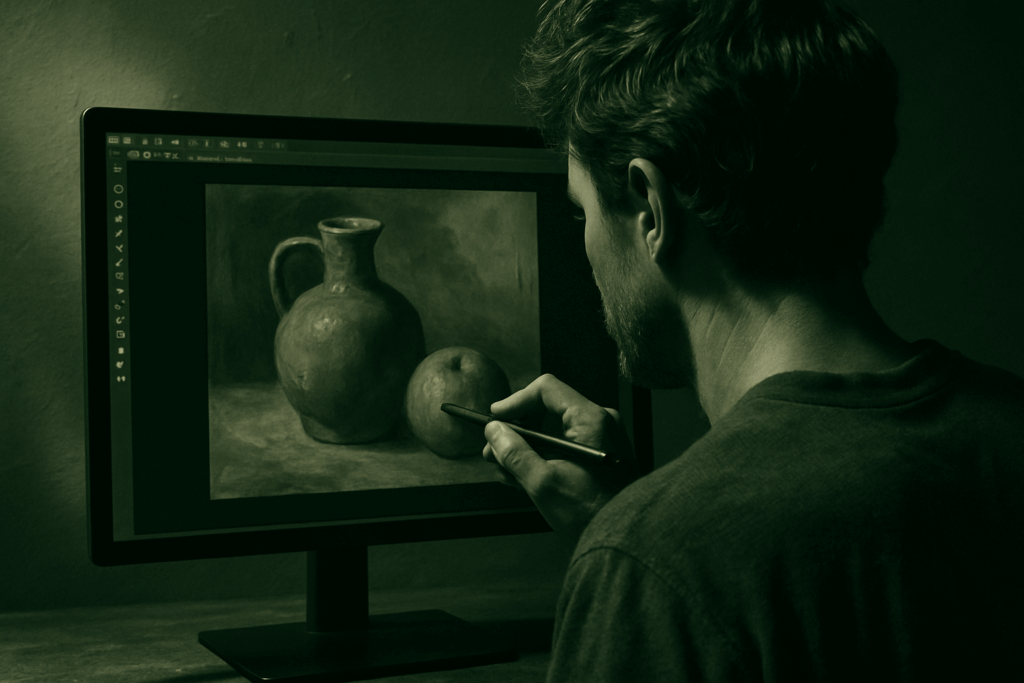
Why Technique Shapes Identity
An artist’s subject might catch the eye, but it’s the brushwork that holds attention. Whether it’s the heavy handed strokes of impasto or the restraint of a dry brush, how the paint hits the surface speaks louder than the image itself. Technique becomes identity. You can copy a composition, but you can’t easily mimic the hand that made it.
Brushwork isn’t just a skill it’s a signature. One artist paints with chaos, layering color in erratic, emotional waves. Another pares everything back to a few minimal sweeps. Each approach builds character and creates a sense of rhythm viewers can almost feel. Even without knowing it, we read brush styles like handwriting, sensing the pace, pressure, and presence of the painter just by looking.
This is where technique turns into voice. It tells you if the artist was impatient, contemplative, raw, or refined. It adds subtext to the surface. That’s why painters don’t just train their hands; they train their instincts. Because over time, that repeated flick of the wrist shapes their visual language and eventually, their legacy.
Dry Brush: This technique thrives on restraint. By running a mostly dry brush loaded with minimal pigment over a rough surface, you reveal texture cracks, wrinkles, grain. It’s perfect for capturing age, grit, or motion with attitude. Think windswept cliffs or broken down barns this is where dry brush shines.
Glazing: If dry brush is grit, glazing is grace. Using thin, translucent layers over dry paint, you build light and color slowly. Each pass subtly shifts the tone underneath, making it ideal for glowing skin tones, atmospheric lighting, or a glass like finish. It demands patience but rewards with luminous depth.
Scumbling: Less smooth, more smoke. Scumbling means dragging a lighter, broken brushstroke over a darker surface. It leaves flecks of color that feel unplanned like mist rolling in or old paper fading. It’s controlled chaos that can warm up a flat space or suggest mood without overt detail.
Impasto: This is brushwork with weight. Thick, raised paint marks stand off the canvas and catch real light. Whether made with palette knife or bristle, impasto is physical and loud. It conveys emotion in volume joy, rage, urgency all baked into the paint itself.
Feathering: The opposite of impasto. Here, the brush barely touches. It softens edges and builds gentle transitions, a natural fit for skin, fabric, or any area where form dissolves into light. Feathering whispers. In a portrait, it’s the difference between studied accuracy and something you can feel.
Technique Meets Medium
Brushwork doesn’t live in a vacuum it changes with the paint you choose. Acrylics dry fast, so there’s little time to play. You load the brush, strike quick, and commit. The work here is often bold, layered, almost impatient. Oils, in contrast, allow room to breathe. Each stroke blends, smears, and stretches. Great for expressive gestures and tonal depth. Watercolors? Totally different beast. They reward restraint. Every brushstroke counts. Too much water, and it floods. Too little, it cracks. Precision here isn’t optional it’s survival.
Choosing the right brush also matters. Round brushes offer versatility, great for lines and detail. Filberts blur edges while keeping control ideal for portraits and subtle blending. Fan brushes spread pigment lightly, useful for texture or lifting paint. Matching the right shape to the right medium unlocks not just good technique, but your own rhythm as an artist.
Examples From the Field
A signature brush technique isn’t just an aesthetic choice it’s a calling card. Take Vincent van Gogh. His signature? Thick, directional impasto strokes. You don’t just see his sunflowers you feel the wind in them. What started as experimentation became a method that anchored his emotional world on canvas.
Then there’s Jenny Saville. Her colossal portraits are built from layered, smeared, and feathered brushwork. Each stroke is raw, anatomical, and deliberate. Over time, she’s honed a visual language that doesn’t try to smooth over the body it throws it into sharp relief, celebrating imperfections through aggressive mark making.
Or consider Yayoi Kusama’s polka dot patterns and repetitive brush dots. What seems obsessive is actually meditative. Her brushwork has evolved from tightly controlled forms to sprawling, immersive environments. Same marks, different scale but unmistakably hers.
In each case, it’s not about mastering a hundred techniques. It’s about digging deep into one, finding its limits, and pushing past them. That’s where identity lives.
Where to See Brushwork Up Close
If you really want to understand brush technique, you need to see it in the flesh. Reproductions whether digital or printed flatten texture, blur stroke detail, and kill scale. In person, brushwork has weight. You see the edge of a loaded bristle, the groove of a dragged line, the way light plays off thick paint. None of that translates through a screen.
Galleries that focus on technique heavy work are your best bet. You’ll find artists layering glazes for days, or hammering out bold impastos with painter’s knife energy. These places don’t just showcase finished pieces they reveal a craft. One worth standing in front of.
Plan a trip to a venue like Arca Gallery, known for spotlighting artists who don’t shy away from visible labor on canvas. It’s a reminder: the brush isn’t just a tool it’s a voice.
Learn more about the gallery
Taking Technique into Your Own Hands
Every artist has a visual fingerprint your brushwork is a big part of it. But you don’t find your style by sitting around waiting for it. You find it by painting. A lot. Then painting differently.
Here are a few dead simple ways to push your technique:
Set a timer for 10 minutes. Paint the same object with a different brush each round flat, filbert, fan, even a toothbrush.
Try speed painting with a limited color palette. Focus on texture, not perfection.
Mimic an artist whose work feels nothing like yours then analyze what surprised you.
Paint with your non dominant hand for one full session. It’ll force looseness and intention.
Use these exercises to test how brush angle, pressure, and rhythm affect tone and mood. Log what feels natural. Log what doesn’t but might with practice.
The more fluent you get with the technical stuff, the freer your creative decisions become. That’s the goal. Not just to master a technique, but to trust your hand when it’s time to break the rules.
Want to see technique in action? Head to Arca Gallery’s site—they feature artists with unmistakable visual voices. Worth a visit.

 Bernardon Holmanate has opinions about art techniques and methods. Informed ones, backed by real experience — but opinions nonetheless, and they doesn't try to disguise them as neutral observation. They thinks a lot of what gets written about Art Techniques and Methods, Trends in Contemporary Art, Exhibition Announcements and Reviews is either too cautious to be useful or too confident to be credible, and they's work tends to sit deliberately in the space between those two failure modes.
Reading Bernardon's pieces, you get the sense of someone who has thought about this stuff seriously and arrived at actual conclusions — not just collected a range of perspectives and declined to pick one. That can be uncomfortable when they lands on something you disagree with. It's also why the writing is worth engaging with. Bernardon isn't interested in telling people what they want to hear. They is interested in telling them what they actually thinks, with enough reasoning behind it that you can push back if you want to. That kind of intellectual honesty is rarer than it should be.
What Bernardon is best at is the moment when a familiar topic reveals something unexpected — when the conventional wisdom turns out to be slightly off, or when a small shift in framing changes everything. They finds those moments consistently, which is why they's work tends to generate real discussion rather than just passive agreement.
Bernardon Holmanate has opinions about art techniques and methods. Informed ones, backed by real experience — but opinions nonetheless, and they doesn't try to disguise them as neutral observation. They thinks a lot of what gets written about Art Techniques and Methods, Trends in Contemporary Art, Exhibition Announcements and Reviews is either too cautious to be useful or too confident to be credible, and they's work tends to sit deliberately in the space between those two failure modes.
Reading Bernardon's pieces, you get the sense of someone who has thought about this stuff seriously and arrived at actual conclusions — not just collected a range of perspectives and declined to pick one. That can be uncomfortable when they lands on something you disagree with. It's also why the writing is worth engaging with. Bernardon isn't interested in telling people what they want to hear. They is interested in telling them what they actually thinks, with enough reasoning behind it that you can push back if you want to. That kind of intellectual honesty is rarer than it should be.
What Bernardon is best at is the moment when a familiar topic reveals something unexpected — when the conventional wisdom turns out to be slightly off, or when a small shift in framing changes everything. They finds those moments consistently, which is why they's work tends to generate real discussion rather than just passive agreement.