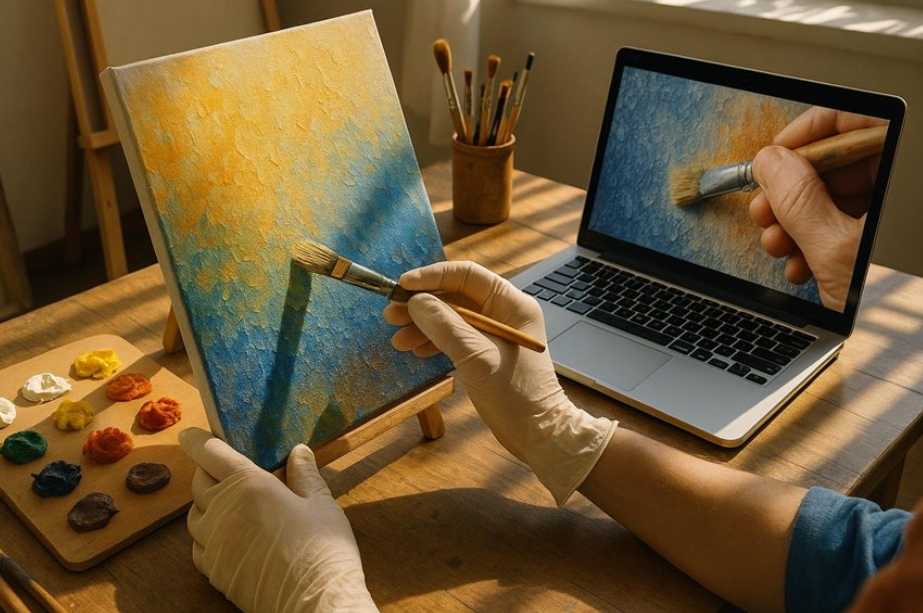
Online fine art schools teach classical layering and scumbling through engaging video tutorials that allow you to see techniques in action. You can pause and rewind to master each step. Interactive workshops offer hands-on demonstrations, letting you practice alongside others. Personalized feedback from experienced instructors helps you refine your skills and discover your unique style. With the right tools and environment, you’ll gain confidence in your artistic abilities. Discover more ways to enhance your creative journey ahead!
Practical Techniques for Layering and Scumbling in Remote Learning
As you immerse yourself in the world of layering and scumbling in your online fine art classes, you’ll discover how these techniques can elevate your artwork.
Layering techniques involve applying multiple transparent washes to create depth and richness. Start with a base layer and gradually add colors, allowing each to dry before adding another.
Scumbling methods, on the other hand, involve lightly brushing a broken or opaque color over dried layers. This adds texture and complexity.
Experiment with different brushes to achieve varied effects, and don’t hesitate to mix mediums to enhance your results.
You’ll find that mastering these methods allows for greater freedom in expression, transforming your pieces into vibrant stories full of dimension and life.
Watch Engaging Video Tutorials for Better Learning
Mastering layering and scumbling can be greatly enhanced by watching engaging video tutorials. These resources allow you to visualize techniques in real time, making complex methods easier to grasp.
Video engagement plays a fundamental role in your learning process, as seeing an artist in action provides context that written instructions often lack, similar to the interactive approach used in online middle school programs. You can pause, rewind, and rewatch sections, tailoring your learning experience to fit your pace and curiosity.
The effectiveness of these tutorials shines when you’re able to absorb nuances and subtleties that might otherwise go unnoticed. So, immerse yourself in a variety of instructional videos, explore different styles, and find what resonates with you.
This freedom in learning will empower your artistic journey like never before.
Interactive Workshops for Artists
While you might think that traditional classroom settings are the only way to learn art techniques, interactive workshops offer a dynamic alternative that can elevate your skills considerably.
These sessions foster creativity and connection, allowing you to explore and refine your artistic voice through:
- Virtual collaborations with fellow artists, expanding your perspective.
- Hands-on demonstrations that guide you in real-time, making learning tactile even from a distance.
- Online critiques that provide constructive feedback, helping you identify strengths and areas for growth.
- Engaging discussions that inspire new ideas and techniques, enriching your artistic journey.
These workshops empower you to break free from conventional learning, embracing innovation and community while honing your craft.
The freedom to learn in this interactive way makes art more accessible and enjoyable.
Get Personalized Feedback to Elevate Your Art
Getting personalized feedback can considerably elevate your art, as it provides tailored insights that generic critiques often miss. When you seek a personalized critique, you’re not just hearing opinions; you’re gaining constructive advice that resonates with your unique style and goals.
This one-on-one engagement fosters artistic growth, helping you identify strengths and areas for improvement. Online fine art schools often offer platforms for interaction, allowing you to receive specific guidance from experienced instructors.
Essential Tools for Remote Art Education
When starting on remote art education, having the right tools is essential for a successful learning experience.
Your online studio setup can be a creative haven with the following essentials:
- Digital Art Supplies: Invest in a good quality drawing tablet and stylus to create stunning digital artwork.
- High-Speed Internet: Verify your connection is reliable for smooth video calls and streaming lessons.
- Art Software: Familiarize yourself with programs like Adobe Creative Suite or Procreate to enhance your skills.
- Camera and Microphone: Clear visuals and sound improve communication with instructors and peers, making feedback more effective.
With these tools, you’ll embrace the freedom to explore your artistic abilities and connect with a vibrant online community.
Conclusion
In today’s digital age, mastering classical layering and scumbling techniques online can feel like painting with a brush made of lightning. With engaging video tutorials, interactive workshops, and personalized feedback, you’ve got everything you need to elevate your art from the comfort of home. Embrace these resources, experiment with essential tools, and watch your skills flourish. Remote learning isn’t just effective; it’s a vibrant community where your creativity can thrive, no matter where you are.

 Bernardon Holmanate has opinions about art techniques and methods. Informed ones, backed by real experience — but opinions nonetheless, and they doesn't try to disguise them as neutral observation. They thinks a lot of what gets written about Art Techniques and Methods, Trends in Contemporary Art, Exhibition Announcements and Reviews is either too cautious to be useful or too confident to be credible, and they's work tends to sit deliberately in the space between those two failure modes.
Reading Bernardon's pieces, you get the sense of someone who has thought about this stuff seriously and arrived at actual conclusions — not just collected a range of perspectives and declined to pick one. That can be uncomfortable when they lands on something you disagree with. It's also why the writing is worth engaging with. Bernardon isn't interested in telling people what they want to hear. They is interested in telling them what they actually thinks, with enough reasoning behind it that you can push back if you want to. That kind of intellectual honesty is rarer than it should be.
What Bernardon is best at is the moment when a familiar topic reveals something unexpected — when the conventional wisdom turns out to be slightly off, or when a small shift in framing changes everything. They finds those moments consistently, which is why they's work tends to generate real discussion rather than just passive agreement.
Bernardon Holmanate has opinions about art techniques and methods. Informed ones, backed by real experience — but opinions nonetheless, and they doesn't try to disguise them as neutral observation. They thinks a lot of what gets written about Art Techniques and Methods, Trends in Contemporary Art, Exhibition Announcements and Reviews is either too cautious to be useful or too confident to be credible, and they's work tends to sit deliberately in the space between those two failure modes.
Reading Bernardon's pieces, you get the sense of someone who has thought about this stuff seriously and arrived at actual conclusions — not just collected a range of perspectives and declined to pick one. That can be uncomfortable when they lands on something you disagree with. It's also why the writing is worth engaging with. Bernardon isn't interested in telling people what they want to hear. They is interested in telling them what they actually thinks, with enough reasoning behind it that you can push back if you want to. That kind of intellectual honesty is rarer than it should be.
What Bernardon is best at is the moment when a familiar topic reveals something unexpected — when the conventional wisdom turns out to be slightly off, or when a small shift in framing changes everything. They finds those moments consistently, which is why they's work tends to generate real discussion rather than just passive agreement.